793
Lindisfarne
The sack of the monastery on the island off the Northumbrian coast. It is from this report that European chronicles date the beginning of the age.
793 — 1066
Three hundred years in which people from the northern fjords reached from Newfoundland to Baghdad. Everything known about them is here — and an honest mark wherever it is not known.
Where to start
A viking was a job, not a people
Old Norse víkingr meant a man on a sea expedition. You could go “viking” for a single season and come back to your farm, your livestock and your lawsuit against the neighbour.
The peoples were the Danes, the Svear and the Norwegians. The vast majority of them sailed nowhere: they ploughed, fished, went to law at the thing and buried their dead much as their neighbours did across northern Europe.
And those who did put to sea traded more often than they raided. The silver in Scandinavian hoards is mostly Arab dirhams that came along the Volga route, not loot from English monasteries.
How far they got
Three directions shape the map of the age: the Western route, the Eastern route and the North Atlantic. Drag the time slider: routes and settlements appear in the year they become known.
Interactive journeys
Everything known as of 1066 is shown: routes and settlements do not disappear from the map as the year advances.
273
years of the age
from Lindisfarne to Stamford Bridge
9
routes on the map
from Vinland to Baghdad
20
towns
under the names they had at the time
111
facts
113 and links to sources
From the age into your phone
Bluetooth is named after a tenth-century Danish king
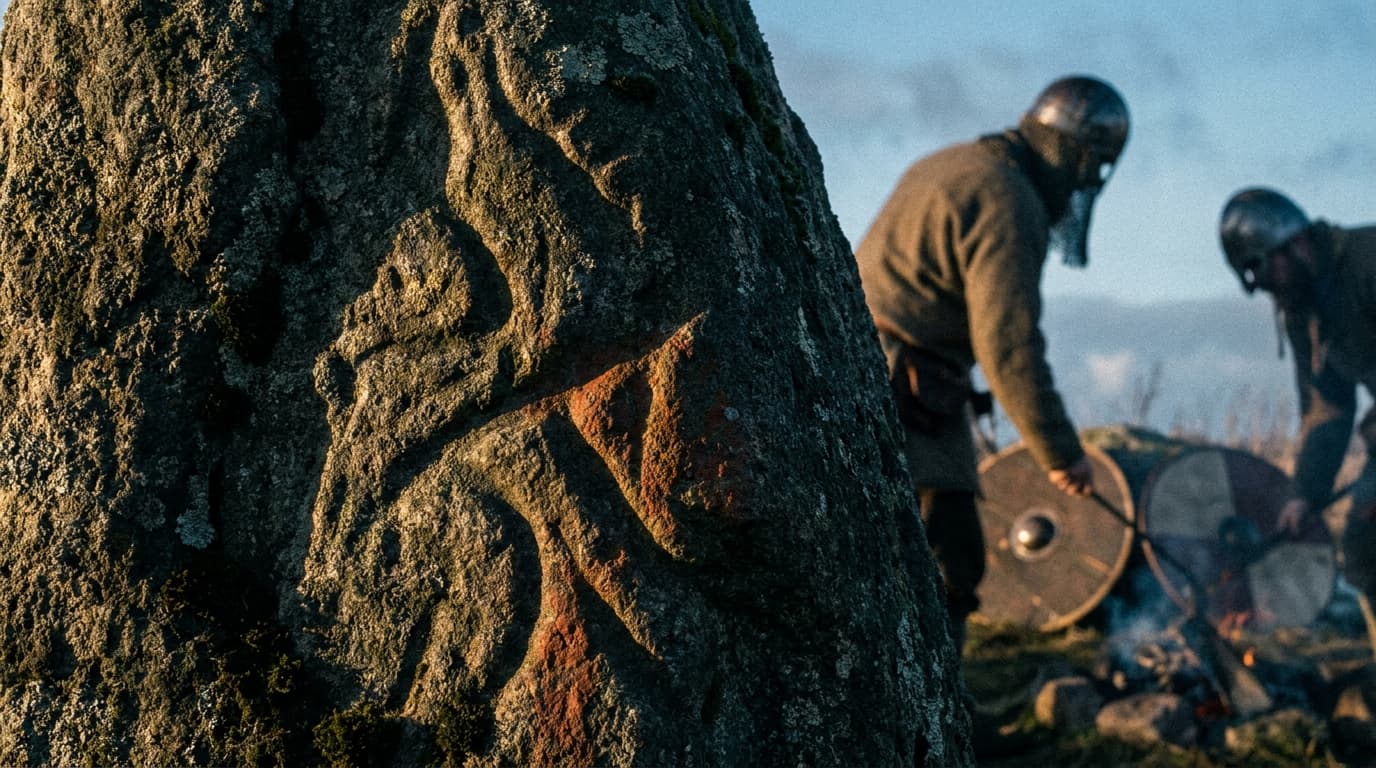
Harald Bluetooth united Denmark and Norway; the technology was meant to unite devices from different makers in the same way. The mark joins two runes, ᚼ and ᛒ — his initials in the Younger Futhark.
Nine sections
Myths against facts
Commonly believed
«Vikings wore horned helmets»
Commonly believed
«The Vikings were a people»
Commonly believed
«They were filthy, unwashed savages»
Commonly believed
«Everyone who fell in battle went to Valhalla»
Commonly believed
«Runes are secret magical symbols»
Commonly believed
«All they did was raid»
How it all ends
The wolf will break its chain and the stars will fall
Ragnarök is neither a punishment nor the end of everything: after the gods fall, the earth rises from the sea again, and two people who sheltered in the branches of Yggdrasil repopulate it. The Norse apocalypse is a cycle.
Twelve dates
793
The sack of the monastery on the island off the Northumbrian coast. It is from this report that European chronicles date the beginning of the age.
841
A longphort — a fortified ship station — is established where Dublin will grow, and the city grows out of it.
845
A fleet comes up the Seine to Paris. The Franks buy it off in silver — a manoeuvre that will be repeated many times.
865
What arrives in England is not a band after plunder but an army that stays for the winter and takes land. Raiding turns into conquest.
874
According to the Book of Settlements, Ingólfr Arnarson establishes the first permanent farm on the island.
911
The king of the West Franks grants land at the mouth of the Seine to the chieftain Rollo. Vikings become vassals and landowners.
922
An Arab envoy meets the Rus near Bulgar and describes in detail their appearance, their customs and the funeral of one of their chieftains.
930
An all-Iceland assembly of free people gathers at Þingvellir. It will meet without a break until 1798.
965
Harald Bluetooth raises a stone inscribed with the claim that he united Denmark and Norway and “made the Danes Christian”.
986
Erik the Red leads settlers from Iceland to south-west Greenland and founds the Eastern Settlement.
1021
The exact year the Norse were at L’Anse aux Meadows. Established from the cosmic-ray spike of 993 recorded in tree rings.
1066
Harald Hardrada dies in England. The date is conventionally taken as the end of the Viking Age — although three weeks later England will be taken by the descendants of other Norsemen, the Normans.
Swipe sideways →