The Elder Futhark had 24 characters.
It was in use from roughly the second to the eighth century. The name is simply its first six characters in order: f, u, þ, a, r, k.
Section 7 of 9
Two futharks, three thousand stones, and everyday notes scratched on sticks.
Sixteen characters — everything the Viking Age wrote with. The straight lines and the absence of horizontals are not a style but a consequence of the material: runes were cut into wood along the grain, and a horizontal stroke would simply be lost in the texture.
 ᚠ
ᚠfeh · Younger Futhark
Sixteen characters · 9th–11th centuries · a script, not a divination system
Field note
04
Epigraphy
archaeological find
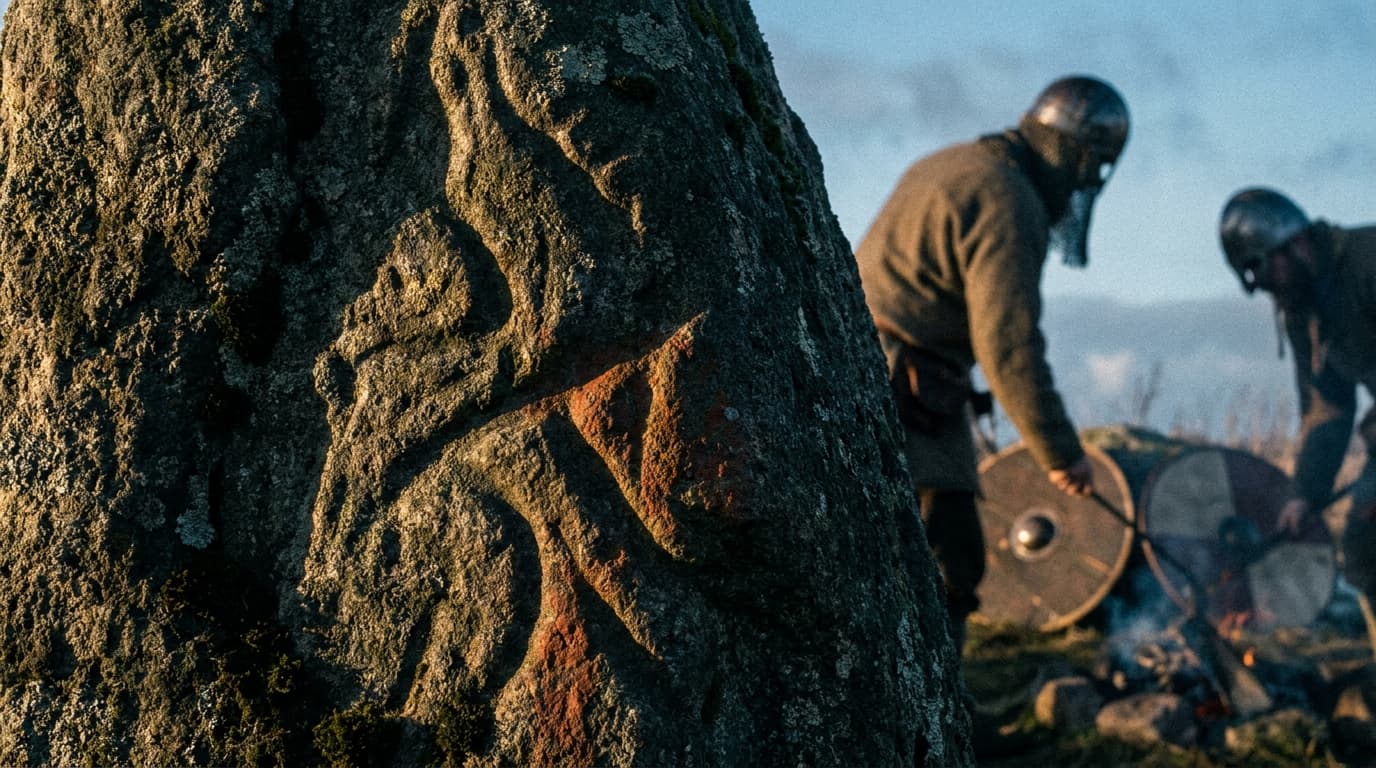
Unna’s late-eleventh-century stone names its female patron, her son and a Christian prayer. Such monuments were made by specialist carvers and workshops, and stood by roads and bridges as public statements of memory, kinship and family standing.
—
This is a transliteration of sound, not a translation. Modern names were not written in runes in the Viking Age, and no one has a “rune name”.
The Younger Futhark has only 16 characters, so t and d, k and g, b and p are written identically — there is no way back from the runes to the original word.
11 entries
It was in use from roughly the second to the eighth century. The name is simply its first six characters in order: f, u, þ, a, r, k.
A paradox: over that time the language grew more complex while the characters grew fewer. One sign came to stand for several sounds at once — which is why t and d are written the same way.
They are densest in Uppland. Most of the stones already belong to the eleventh century — that is, to the very end of the age and its Christian close.
Hundreds of inscribed wooden sticks were found at Bergen: trade notes, names, declarations of love and obscenities. The magical aura around runes is largely a nineteenth- and twentieth-century inheritance.
The inscription states that Harald united Denmark and Norway and “made the Danes Christian”. The stone still stands at Jelling.
The technology was meant to unite different devices the way Harald united lands. The mark joins ᚼ and ᛒ — his initials in the Younger Futhark.
More than seven hundred characters, some of them enciphered. What it actually says is argued over to this day.
Runes are carved on the marble lion taken from Piraeus to Venice. They are traces of the same men who served in the emperor’s Varangian Guard.
Straight lines and the absence of horizontals follow from carving wood along the grain. A horizontal stroke would simply be lost in the texture.
The Rök stone in Sweden, early ninth century, is covered in writing on every side. A father raised it in memory of his son — and encoded the text so thoroughly that its meaning is still argued about.
Bind runes saved space on the stone and worked as a monogram. The same device underlies the Bluetooth mark: Harald Bluetooth’s two runes fused into one symbol.