The word “viking” named an occupation, not a people.
Old Norse víkingr meant a man on a sea expedition. You could go “viking” for a season and come back to your farm. The peoples were the Danes, the Svear and the Norwegians, and most of them never sailed anywhere.
The age is conventionally counted from the sack of Lindisfarne in 793.
It was not the first Norse appearance in Britain, but the first to shock the chroniclers enough to enter every annal at once. The date is a convention: a convenient starting point, not a switch being thrown.
In 865 an army came to England and stayed through the winter.
The Great Heathen Army behaved unlike the bands that came for plunder: it took land and redrew the political map. Raiding had turned into conquest.
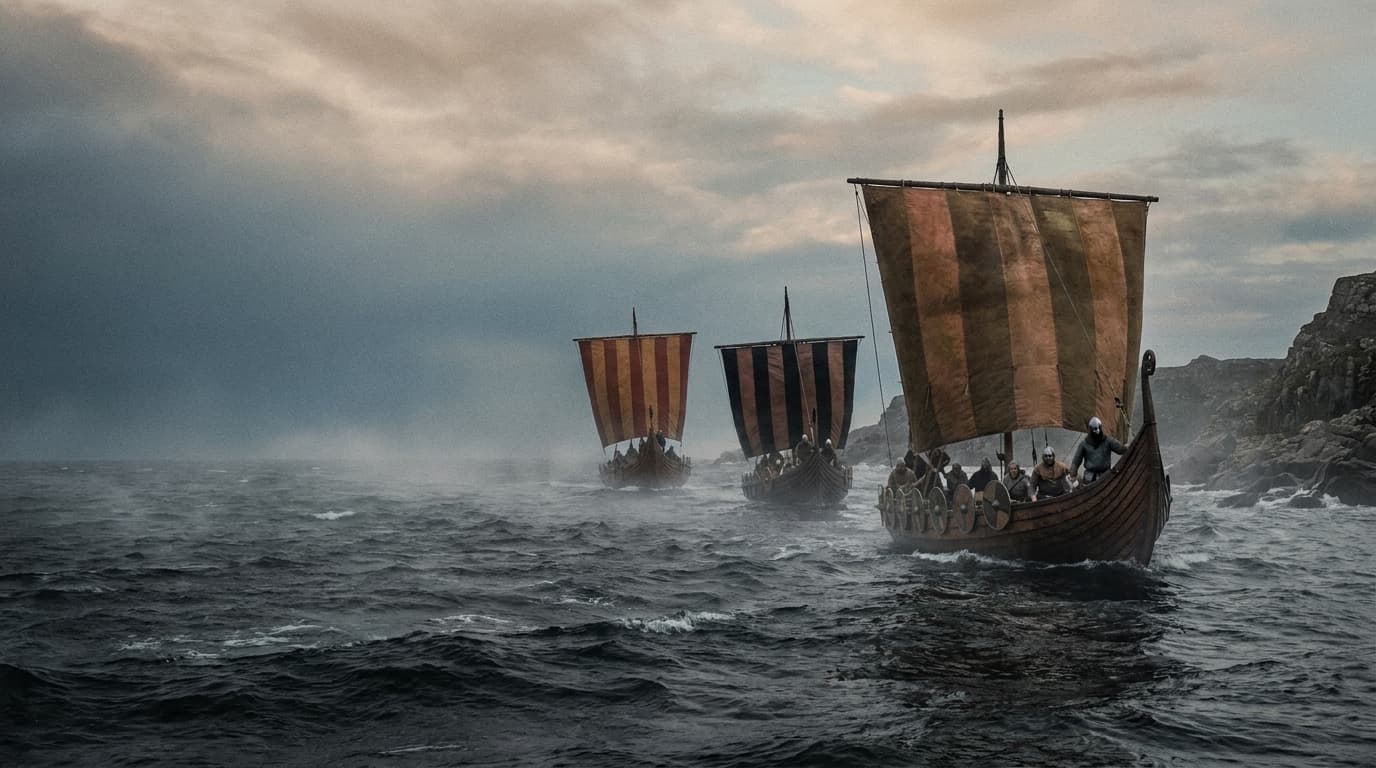
The ships’ shallow draught let them go far up rivers into the interior.
A draught of about a metre meant a fleet did not have to wait for a convenient harbour. In 845 the ships came up the Seine to Paris, and the Franks had to buy them off in silver.
Buying peace with silver was not a disgrace but working practice on both sides.
Danegeld was paid to make a fleet leave. For those paying it was cheaper than war; for those receiving it was steadier income than plunder. The practice lasted more than two centuries.
For several decades the north and east of England lived under Norse law.
The Danelaw left its mark on the English language and on the names of hundreds of villages — the endings -by and -thorpe come from exactly there.
The slave trade was one of the pillars of the Norse economy.
Captured people were sold in markets from Dublin to Bulgar. It sits awkwardly in tourist brochures, but without it the picture of the age is incomplete and untrue.
Normandy takes its name from the “north men” it was granted to in 911.
A century and a half later Rollo’s descendant William conquered England. So 1066 is both the end of the Viking Age and its delayed continuation.