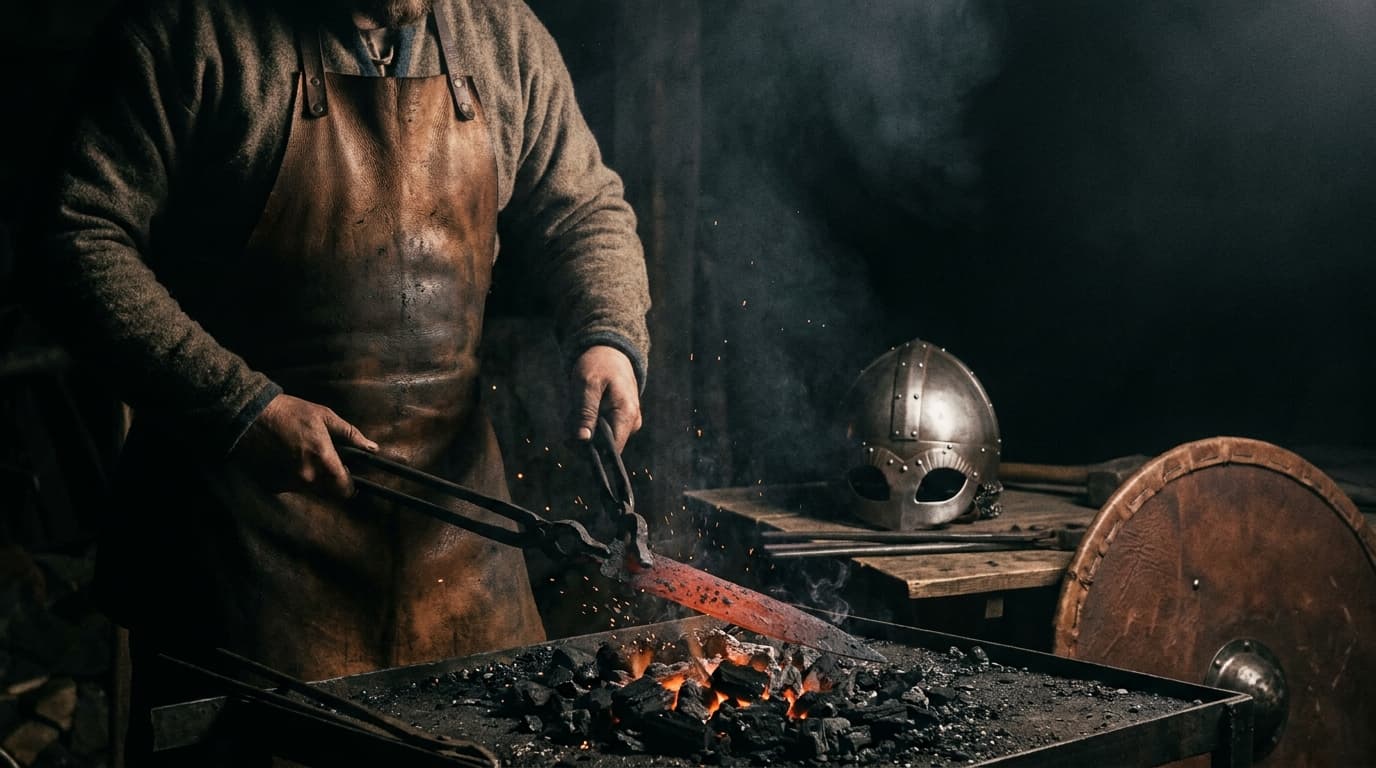
The main weapon was the spear, not the sword.
A spear is cheap, made from a strip of iron and a shaft, reaches at a distance and works in formation. A sword cost as much as a good herd and few owned one — which is why everybody has one in the films and far from everybody has one in the graves.
There was a brand of blades — the inscription +VLFBERH+T inlaid in the steel.
Some fifty surviving swords carry the name, and part of them are made of crucible steel that Europe did not produce at the time — the material came from the east. Contemporary fakes exist too, with the crosses placed wrongly.
Swords bore names and were handed down.
A blade outlived its owner and was family property, not a consumable. That is why a sword so often ends up in a grave: it was parted with the way a person is.
The shield was round, light and expendable.
Thin lime or spruce boards, a rawhide binding round the rim and an iron boss at the centre with the fist behind it. Such a shield was not built to last: it absorbs a blow by splitting.
Exactly one complete Viking Age helmet has ever been found.
The helmet from Gjermundbu in Norway: a rounded cap of iron bands and a half-mask guarding the eyes and nose. Everything else we “know” about helmets of the age is reconstructed from fragments and images.
Mail was a rarity, not the kit of an ordinary fighter.
Tens of thousands of rings, every one riveted by hand. That is months of a smith’s work and the price of an entire farm. Most men stood in the line in wool and leather.
The two-handed axe appeared late in the age and meant giving up your shield.
A broad blade on a long haft would go through shield and helmet, but the man wielding it stood unprotected. He could only work from behind the line — a weapon of discipline, not of fury.
A war axe differed from a working one by being lighter, not bigger.
A household axe has a heavy poll for splitting firewood. A war axe has a thin, wide blade and little weight — it is for striking fast, not for chopping all day.
Everyone carried a large knife — the seax.
A single-edged all-purpose blade: a tool and a weapon of last resort. It turns up in men’s and women’s graves alike, because it is first of all a household object.
The shield wall is about formation, not fury.
Shields overlap at the rims, spears work over the top, the rear ranks push. The winner is not the man who strikes hardest but the side whose line did not come apart.
A matter of scholarly dispute— what is argued
That the formation existed is not in doubt. What is argued is how tightly the shields locked: some researchers regard the solid “tortoise” as a later literary construction of the sagas and chronicles rather than a description of real fighting, where a man needs room to swing.
Weapons in a grave speak of standing, not of occupation.
A sword in a grave marks the family’s status. That is why grave goods cannot reliably prove the person buried was a fighter — and that is exactly what the argument over grave Bj 581 at Birka turns on.