In 930 a general assembly of free people met in Iceland.
The Althing at Þingvellir passed laws and settled disputes for two weeks a year. It went on meeting until 1798 — which shows how a Viking Age community organised itself from nothing.
Section 8 of 9
The thing, jarls and thralls, the longhouse, women’s rights — and the Birka grave that overturned the debate about women warriors.
This was a society of free farmers who settled their own disputes at the thing — and at the same time a society in which some people were property. Both halves of the truth are needed at once: without the thing you cannot see why the Icelanders managed without a king, and without the slave trade you cannot see where all that Arab silver in Scandinavia came from.
Field note
05
Survival of evidence
probable reconstruction
Viking Age clothing rarely survives and is usually known from small fragments preserved by chance. Textiles therefore have to be reconstructed from a combination of scraps, written descriptions, small figures and tapestry images.
13 entries, 2 of them disputed
The Althing at Þingvellir passed laws and settled disputes for two weeks a year. It went on meeting until 1798 — which shows how a Viking Age community organised itself from nothing.
The nobility, free farmers and slaves. A thrall had no rights but could be freed or buy himself out — slavery was a condition, not a life sentence.
Compared with their contemporaries elsewhere in Europe, Norse women had more freedom: the right to divorce and to inherit implies an independent legal standing. They ran farms and raised runestones.
Genomic analysis in 2017 found two X chromosomes and no Y, confirming the osteological determination of 2014. The grave goods are a sword, an axe, spears, shields, two horses and gaming pieces.
The sex of the person buried is not in dispute. What is disputed is the conclusion “professional woman warrior”: Judith Jesch of the University of Nottingham called it premature, and other researchers point to the crudeness of the 1878 excavation methods and allow either a secondary burial or a symbolic reading of the grave goods — a mark of family and standing rather than of occupation.
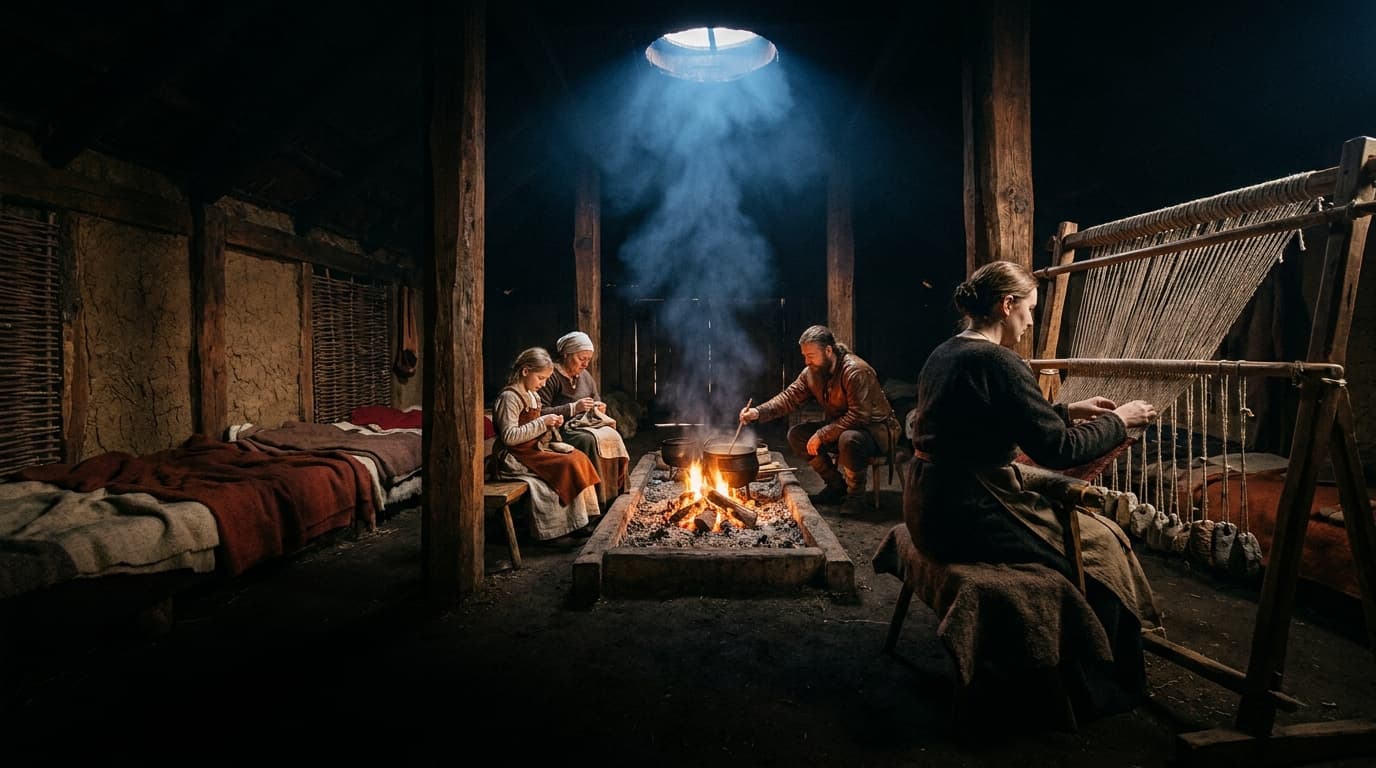
A hearth down the middle, smoke leaving through an opening in the roof, sleeping platforms along the walls. The animals’ warmth was part of the heating.
The holmgang had a procedure: a marked-out ground, an order of blows, conditions for winning. In time it was banned — it turned out to be far too convenient a way of taking other people’s property.
Combs are among the commonest finds of the age. Graves contain tweezers and ear spoons, and Saturday in the Scandinavian languages is still called “washing day”.
The cultured dairy product came to Iceland with the first settlers and has been made there without a break ever since.
The sources describe warriors who fell into a fury and felt no pain. That is the only thing that can be stated with confidence.
The explanations — fly agaric, henbane, alcohol, self-suggestion, ritual practice, or simply a literary device of the sagas — are all unproven. The fly agaric theory was born in the eighteenth century and survives on popularity rather than evidence.
Weak barley ale was brewed constantly and drunk by everyone, children included: boiling made it safer than water. Mead required expensive honey and was served at feasts and rites.
Cod was wind-dried without salt: it lost up to four fifths of its weight, kept for years and came back to life in water. It was both ship’s rations and a commodity Europe paid silver for.
She controlled the stores, could demand a divorce, owned property and inherited it. While her husband was away at sea for a season, the whole farm rested on her.
In hnefatafl one side defends a king at the centre and tries to bring him to the edge of the board; the other is twice as numerous and must surround him. Sets of pieces are found in graves alongside weapons.