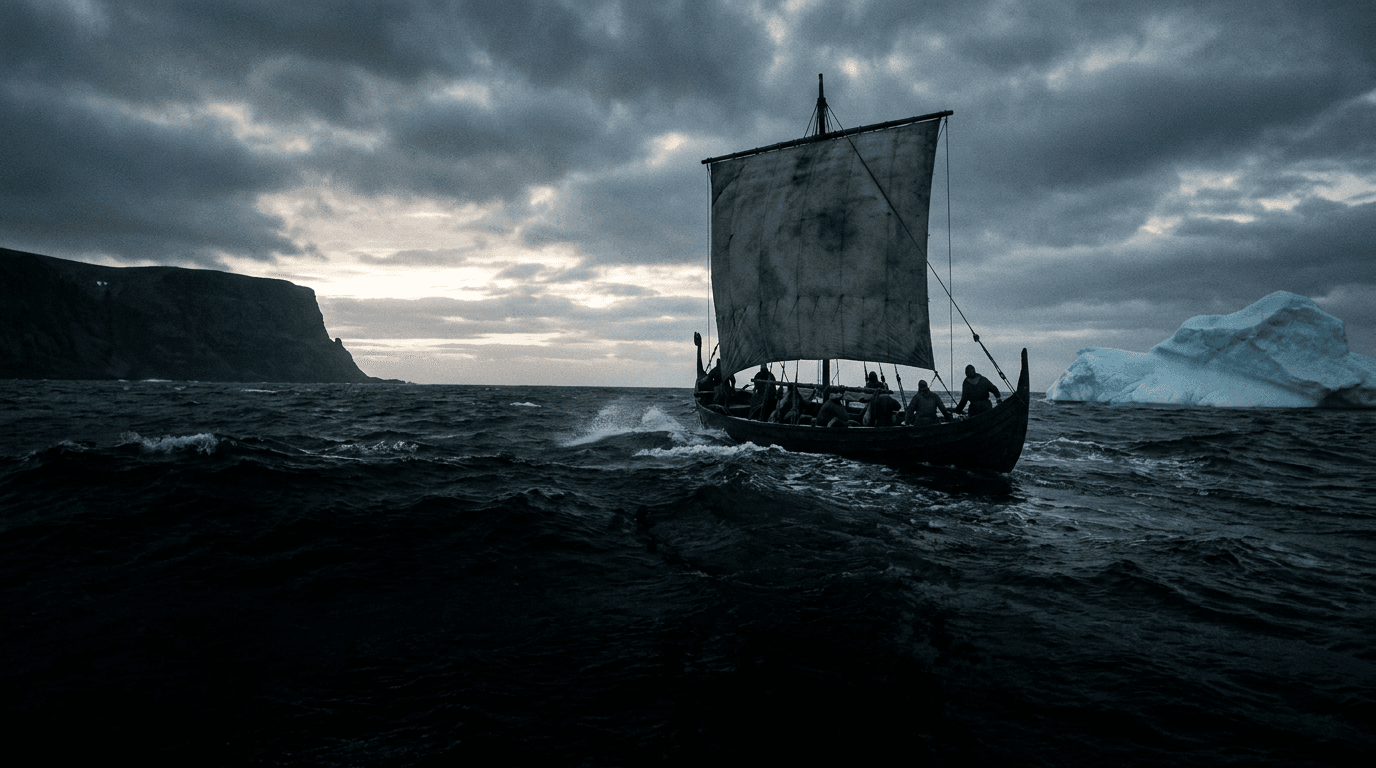
The Faroes and Iceland were settled for the first time: there were no natives there.
This sets the North Atlantic apart from every other direction. There was no raid and nothing taken from anyone: people moved into an empty house, and the adversary was not other men but the weather and the shortage of timber.
A matter of scholarly dispute— what is argued
Ninth-century Irish texts say hermit monks, the papar, lived on the islands before the Norse; Icelandic sources agree, but there is almost no archaeological trace of them. In the Faroes, barley grains and signs of grazing have been found in sediments dated to the fourth to sixth centuries — so someone was there several hundred years before the Norse. Who, exactly, is unknown.
Iceland began to be settled around 870, and the volcanic ash shows it.
The tephra layer of 877 lies directly beneath the first buildings: everything above it belongs to the settlers. The Book of Settlements names more than four hundred first settlers, though it was written down three centuries later.
The name “Greenland” was coined by a man who needed to sell a migration.
Erik the Red was outlawed from Iceland for three years for killing a man. On his return he recruited settlers for an island he called the green land — according to the saga, precisely so that people would be readier to go. Around 985 twenty-five ships set out; fourteen arrived.
Both Greenland settlements stood on the same coast — the western one.
The Eastern and Western Settlements lay some five hundred kilometres apart on the south-west coast; the “eastern” one was simply further south. The names misled later Europeans: for centuries the lost colony was hunted for on the east coast, where nobody had ever lived.
At L’Anse aux Meadows stand the remains of a genuine Norse settlement in America.
Eight turf buildings, a smithy, traces of bog-iron working. It is the only confirmed European settlement in the New World before Columbus — and it was no colony: it looks like a staging base that lasted a handful of years.
The two Vinland sagas tell different stories.
The Saga of the Greenlanders and Erik the Red’s Saga disagree about who sailed west, in what order, and what they found. Both were written down two or three centuries after the events. Archaeology has confirmed that the voyages happened — but not the details, and certainly not the geography.
The meeting with the local people ended in hostility and withdrawal.
The sagas call them skrælingjar. First cloth and milk were traded for furs, then there was fighting. Across the ocean the Norse were outnumbered and had no reinforcements — so they left. The continent was beyond them; it was not a matter of taste.
There was nothing to build with, so houses were built of turf.
In Iceland and Greenland walls were laid up from turf blocks as much as a metre thick, and wood was saved for the frame — imported, or driftwood gathered along the shore. The forests of Vinland were not a curiosity to the Greenlanders but a raw material: that is what they sailed for.
Iceland lost its woodland within a few generations.
When people arrived, roughly a quarter of the island carried open birch woodland. Felling for charcoal and building, together with sheep grazing, cleared almost all of it: today about two per cent is wooded. The restoration is still going on.
The Greenland colony lived on walrus ivory.
Until cheap elephant ivory began reaching Europe from Africa, walrus tusk was the main material for carving: the Lewis chessmen are made of it. A colony at the edge of the inhabited world effectively existed for a single commodity.
The Greenland colony lasted some five hundred years and then vanished.
The last record of it is a wedding at Hvalsey church in 1408. After that, silence: the sources report no disaster and no evacuation.
A matter of scholarly dispute— what is argued
There are several explanations and none accounts for everything. The cooling of the Little Ice Age; exhausted pasture and erosion; the collapse in demand for walrus ivory once African elephant ivory arrived; people drifting back to Iceland and Norway; clashes with the Inuit. There is no evidence of mass death — the settlements appear to have emptied rather than perished.
The Norse were in America in 1021 — 471 years before Columbus.
Three trees at L’Anse aux Meadows were felled with metal tools exactly 28 years after the cosmic-ray spike of 993, which is imprinted in tree rings worldwide. That gave not “somewhere around the year 1000” but an exact year.