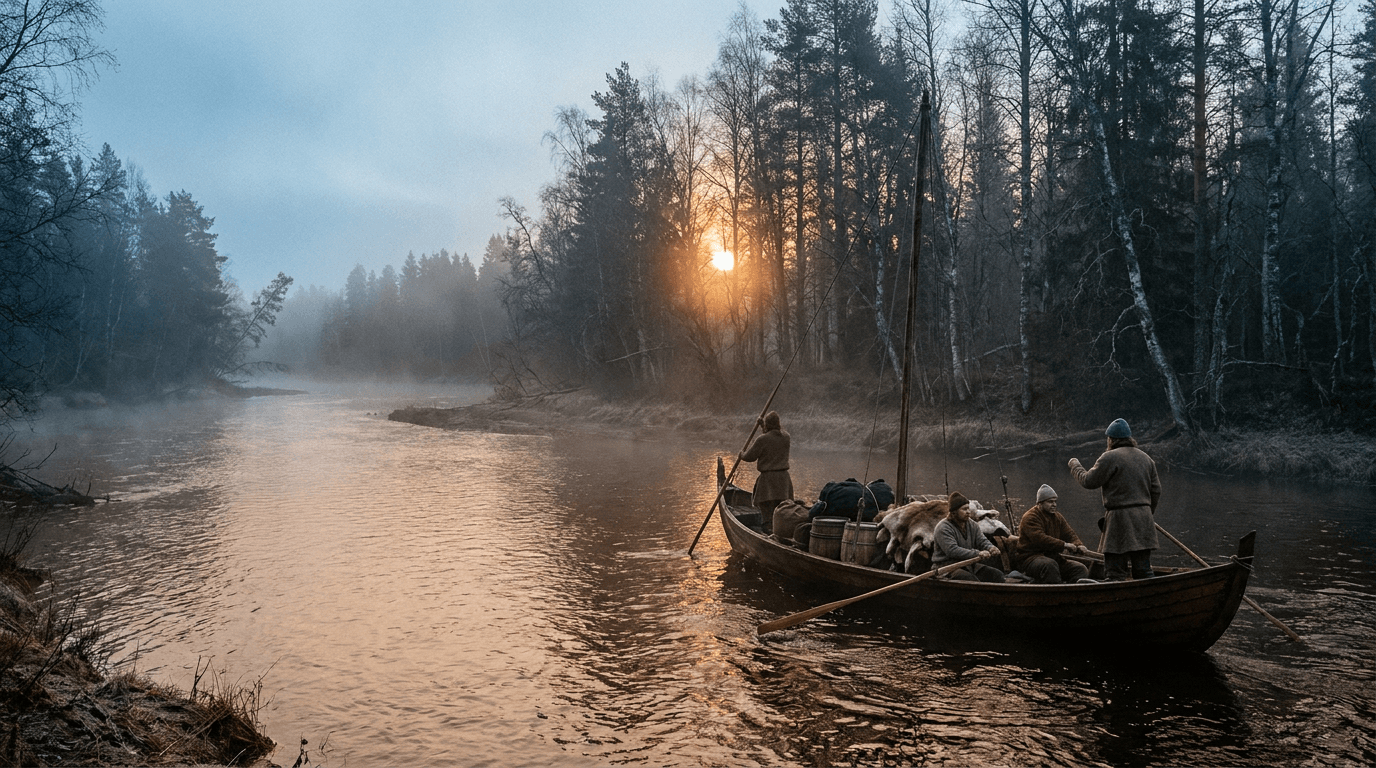
The eastern route opened before the western one.
Tree-ring dates from the buildings at Staraya Ladoga reach back to the 750s — almost half a century before Lindisfarne. The Viking Age is counted from the first raid on the West simply because the West had chroniclers who wrote it down.
In the east these people were called Varangians, not Vikings.
Greek texts call them Βάραγγοι, Slavic ones varyazi. The word most likely comes from Old Norse várar, “pledges”: men bound by a common oath — a company under contract rather than sea raiders.
The Norse called these lands Garðaríki — “the realm of towns”.
The sagas give these places names of their own: Ladoga is Aldeigjuborg, Novgorod is Holmgarðr, Kyiv is Kœnugarðr, Constantinople is Miklagarðr, “the great city”. The names are everyday and practical — the way you speak of places you go to regularly.
People went east to trade and to serve, not to raid.
The west has Lindisfarne, the siege of Paris and the Great Heathen Army. The east has trading posts, written treaties and paid service. This is not about the character of the men: there were no rich undefended monasteries here, but there was a river leading to the caliphate.
Where the word “Rus” itself came from has been argued over for two centuries.
The argument outgrew linguistics long ago and became political, which is why taking a side here would be dishonest: both sides have arguments.
A matter of scholarly dispute— what is argued
The Scandinavian derivation traces the word to Old Norse roðr, “rowing”, by way of Finnish Ruotsi — still the Finnish name for Sweden. Objections point out that the name attached itself very quickly to a Slavic state and its population, and offer Slavic and Iranian explanations instead. No solution is generally accepted.
The funeral of a Rus chieftain was described by an eyewitness — the only such account there is.
Ibn Fadlan watched the rite on the Volga in 922: a ship dragged up onto the bank, ten days of mourning, a slave girl killed, and an old woman presiding whom he calls the Angel of Death. No Norse text describes a burial in such detail. But he did not know the language and judged what he saw by his own standards — the details reach us through a double filter.
Written treaties were made with Byzantium — with the envoys named in them.
The treaties of 907, 911 and 944 survive in the Primary Chronicle: where to house the merchants, how long to feed them, how to try a killing or a theft. The envoys in the lists are called Karl, Farlaf, Vermud, Rulav — Norse names inside a Slavic text.
The Byzantine emperor’s personal guard was recruited from northerners.
The Varangian Guard was formed around 988, when Vladimir of Kyiv sent Basil II six thousand men. The service paid so well that runestones still stand in Sweden raised for men who went “to Greece” and did not come back.
The name “Halfdan” is scratched in runes on the marble of Hagia Sophia.
The inscription is on the parapet of the upper gallery — a bored guardsman on duty, thousands of kilometres from home. Only the name can be read with confidence; the rest has worn away. A second inscription of the same kind was found nearby.
Some twenty-six stones in Sweden were raised for a single expedition that perished.
Ingvar the Far-Travelled led his expedition east around 1041 and almost none of it returned. The Ingvar stones are the largest group of runic monuments commemorating one event, and they all say the same thing: he died in the east.
The flow of eastern silver broke off in the early eleventh century.
Dirhams all but vanish from the hoards after the 1010s: the silver mines of Central Asia were exhausted and minting collapsed. The eastern trade did not “end” by anyone’s decision — it simply ran out of the thing it existed for.
Most of the silver in Scandinavian hoards is Arab coin.
Dirhams came along the Volga route from Bulgar and from the caliphate. Silver was weighed rather than counted: what mattered was the weight of metal, not the face value.
In 922 the Arab envoy Ibn Fadlan described the Rus on the Volga in detail.
His account is a rare outside view: appearance, trade, customs, and the funeral of a chieftain with a ship burnt over him. Valuable testimony, but a partial one — he judged other people’s customs by his own.