The Nordic clinker boat tradition is recognised as UNESCO heritage.
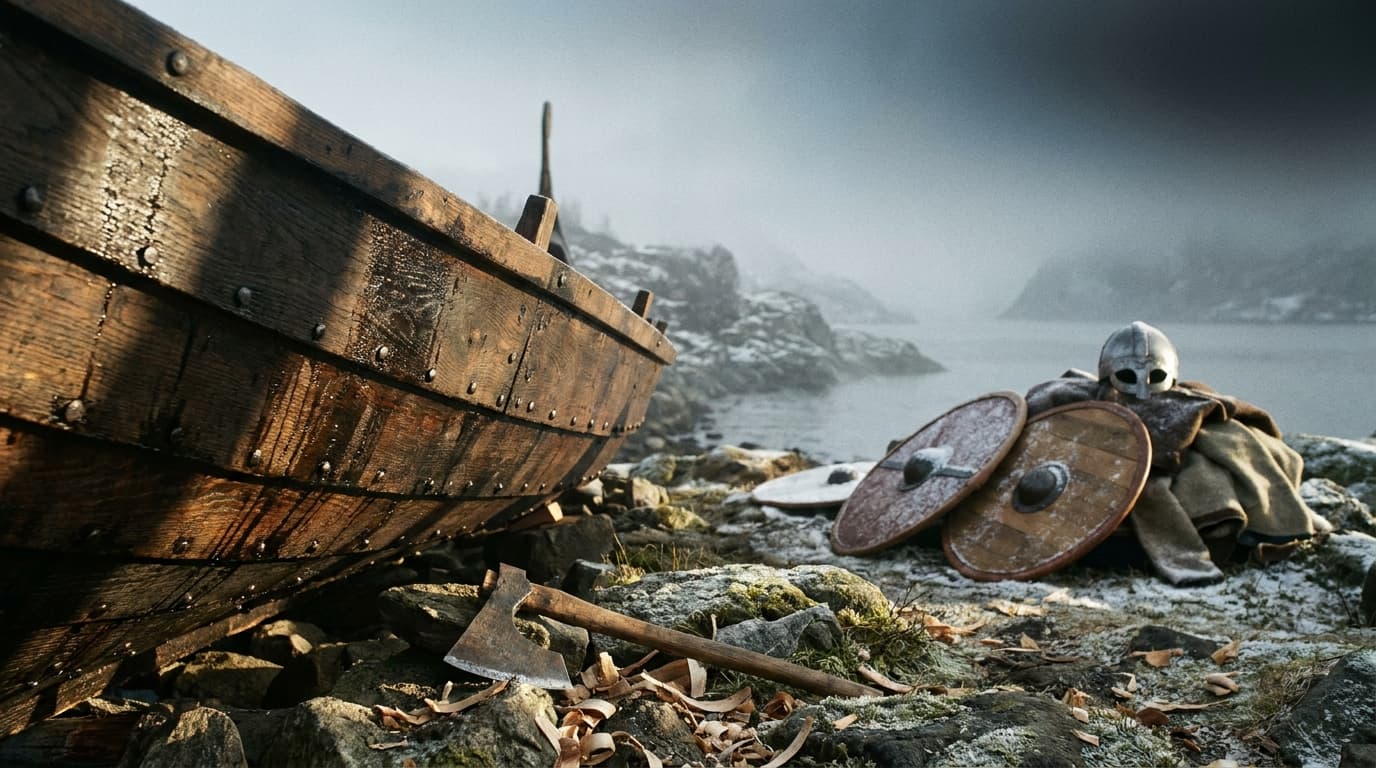
Overlapping planking: thin boards are fixed to the keel and lap over one another, joined by rivets. The technique is nearly two thousand years old and was inscribed on the intangible heritage list on 14 December 2021 on a joint nomination by five countries.
The Oseberg burial is dated to 834, and the two people in it are women.
The wealth of the grave goods indicates that at least one of them held high political and possibly religious standing.
The Gokstad ship was built around 890.
The man buried in it was tall and over fifty, with battle injuries including deep cuts to the legs.
Five ships were scuttled off Roskilde to block the channel.
They were raised in 1962. Skuldelev 1–6 are several different types at once, cargo and war alike, which is what revealed how specialised the fleet really was.
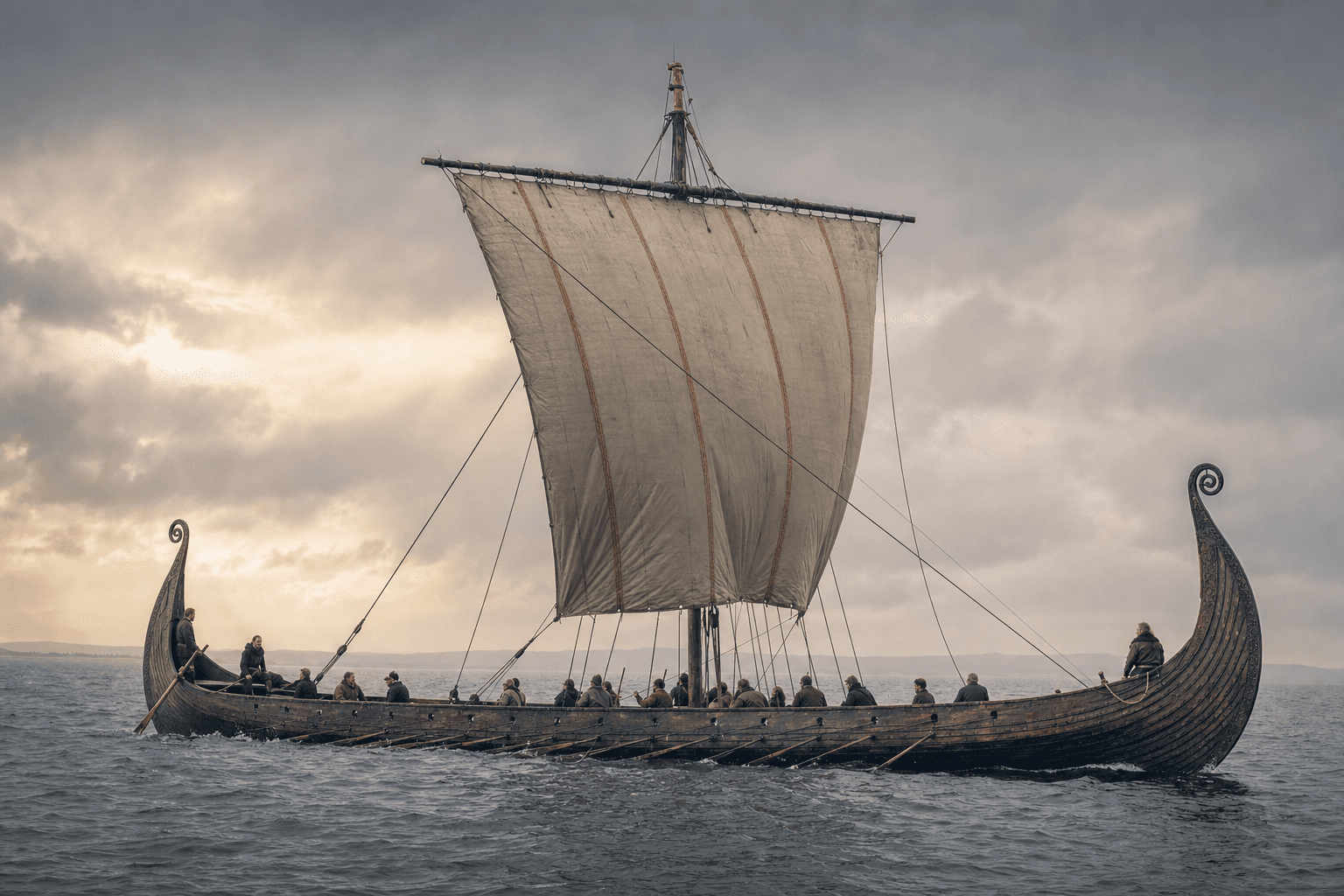
The cargo knarr and the war longship were different vessels for different jobs.
The knarr is broader, deeper and roomier: it carried cargo across the ocean under sail. The longship is narrow and shallow, driven by oars — built for speed and for rivers. The one all-purpose ship is a film invention.
Ship burial went to a handful of people, not to every warrior.
Only a very rich family could afford to bury a serviceable ship under a mound. Most people of the age were buried incomparably more modestly.
Navigating by a “sunstone” remains a hypothesis.
The sagas mention a sólarsteinn, and a crystal of Iceland spar really does let you find the sun in overcast weather from the polarisation of the light. Experiments confirm it.
A matter of scholarly dispute— what is argued
Not one sunstone has been found in a Norse shipboard context, and the saga mention is both too late and too brief. The physics of the method is proven; its use by the Vikings is not.
The Norse crossed the ocean without compass or charts.
They steered by the sun and stars, by the height of the sun above the horizon, by birds, the colour of the water and the currents. They held a latitude and ran along it — a method that needs experience rather than instruments.
Ships were dragged overland between river systems.
This is the only reason the route from the Varangians to the Greeks existed at all: the vessels were light enough to be hauled across land from one river to the next.
The steering oar hung on the right side — hence the English word starboard.
Because the steering oar was on the right, a ship came alongside a quay on its left. That side is still called port in English — the side facing the harbour.
The man buried in the Gokstad ship died in a fight.
A tall man in his forties, with blade cuts on his leg bones that had not begun to heal. The burial is around 900; the ship itself was built about 890.
The Norse sun compass is an attractive hypothesis, not a proven instrument.
A wooden fragment notched around its rim was found at Uunartoq in Greenland. Some researchers take it for part of a navigational instrument that found direction from a shadow.
A matter of scholarly dispute— what is argued
There is a single find, about half of it preserved, and several readings of it: a sun compass, a household object, or a decorated vessel base. Trials with replicas show it could have worked as a compass — but that proves possibility, not purpose.